

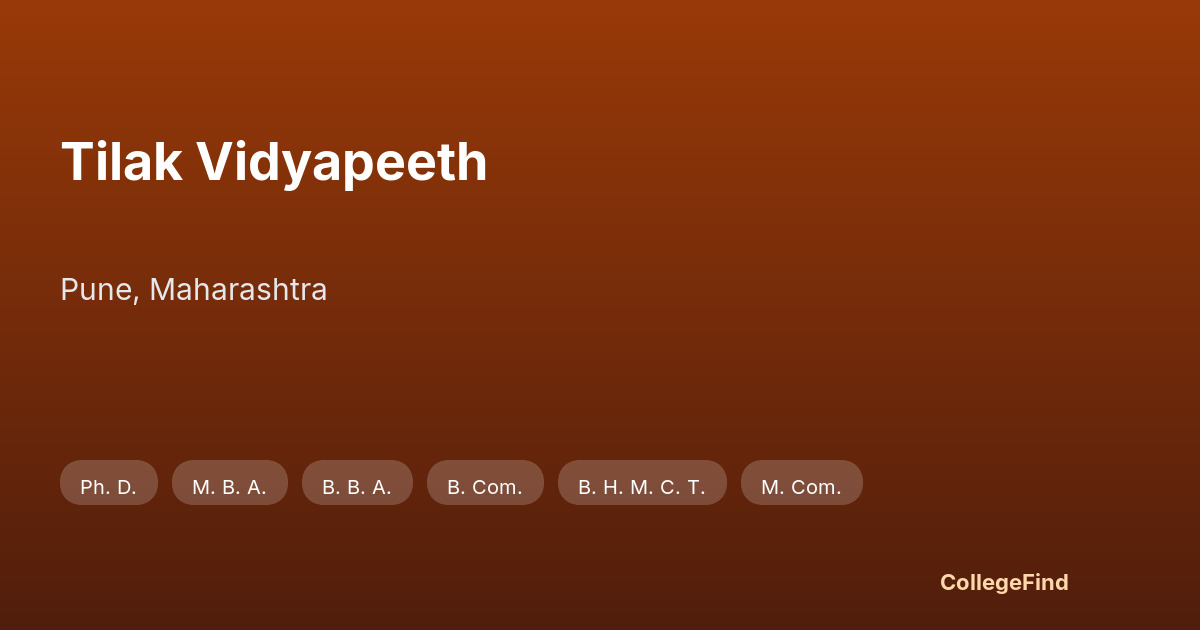

Tilak Vidyapeeth: An In-Depth Overview
Established in 1921, Tilak Vidyapeeth is one of the oldest and most respected institutions located in Pune, Maharashtra. Over the decades, it has evolved into a deemed university with private management, offering a range of academic programs and fostering a vibrant educational atmosphere. This article provides a comprehensive look at the institution, focusing on its academic strengths, campus environment, and the overall outcomes for its students.
Historical Background and Location
Tilak Vidyapeeth was founded in the early 20th century, during a critical period of India's educational development. Situated in the bustling district of Pune, Maharashtra, the university benefits not only from its historical significance but also from the region’s rich cultural and academic landscape. Pune, often called the “Oxford of the East,” is known for its concentration of educational institutes, and Tilak Vidyapeeth contributes significantly to this reputation by providing quality education for over a century.
Academic Programs and Curriculum
As a deemed university operating under private management, Tilak Vidyapeeth offers a variety of courses, primarily focused on traditional and contemporary disciplines. The academic structure emphasizes both theoretical knowledge and practical skills, ensuring a well-rounded education. While detailed course listings and specific departmental information are not broadly publicized, the university maintains a commitment to upholding rigorous academic standards in alignment with its historical mission.
The university’s approach to curriculum design often incorporates an understanding of India’s cultural and social context, which is particularly relevant given the institution’s location in Maharashtra. This regional relevance enhances students’ learning experiences by connecting academic content with real-world scenarios in the district and beyond.
Campus and Facilities
Tilak Vidyapeeth’s campus covers an area of approximately 6.05 acres, providing a compact yet functional environment for students and faculty. The campus infrastructure supports various educational activities, including lecture halls, seminar rooms, and technology-equipped classrooms. Though not sprawling, the space is thoughtfully used to create an inviting atmosphere conducive to learning and research.
Located within Pune’s vibrant urban setting, the campus benefits from easy access to city resources, including libraries, research centers, and cultural institutions. This proximity allows students to engage beyond classroom walls and explore broader educational and career opportunities within the district.
Management and Institutional Governance
Tilak Vidyapeeth operates as a deemed university with private management. This organizational structure provides a degree of autonomy in academic and administrative decisions, helping the institution tailor its programs and policies to meet evolving educational demands. However, specific details about the management team or governance practices are not widely published, suggesting a traditional administrative approach focused on sustaining the institution’s core values.
Student Placement and Career Outcomes
Though exact placement statistics and average salary packages are not readily available publicly, Tilak Vidyapeeth emphasizes preparing students to enter professional environments with confidence. The comprehensive academic training and exposure to Pune’s dynamic economic climate contribute positively to graduate employability.
Given Pune’s role as a commercial and industrial hub in Maharashtra, students have access to various internship and job opportunities across sectors such as education, healthcare, research organizations, and local businesses. This geographical advantage, coupled with the university’s academic foundation, helps graduates transition into their careers effectively.
Conclusion
Tilak Vidyapeeth stands as a notable institution within Pune, Maharashtra, carrying nearly a century of educational tradition. Its status as a deemed university under private management allows it to maintain academic independence, while its campus provides a supportive learning environment for students. Although certain details such as detailed program structures and placement data are limited, the university’s legacy and context within Pune’s rich educational ecosystem make it an important player in the region’s academic landscape.
For prospective students interested in a historically rooted institution that balances tradition with contemporary relevance, Tilak Vidyapeeth represents a viable option in one of Maharashtra’s most vibrant districts.